Transforming Tuition Into Access

As the state’s only public law school, University of Wisconsin Law School has always placed a strong emphasis on access to legal education as a core value.
Ensuring we attract and retain the most competitive students, regardless of their personal and family financial resources, is embedded in our admissions philosophy. UW Law has stayed true to this priority by keeping our cost of attendance as low as possible and by providing need- and merit-based scholarships.
This wouldn’t be possible without you. Our alumni understand what a transformative impact a legal education can have on a student’s life because they have experienced it themselves. They have seen the ripple effects of how our graduates change the lives of those they assist in their communities.
History of UW Law Tuition and Scholarships
UW Law School keeps tuition affordable by keeping increases minimal whenever possible. However, such increases are not always within complete control of the school, so when larger ones have occurred, we have successfully advocated that a part of the revenue produced by a tuition increase be earmarked for need-based scholarships. This has allowed us to provide scholarship assistance to students impacted most.
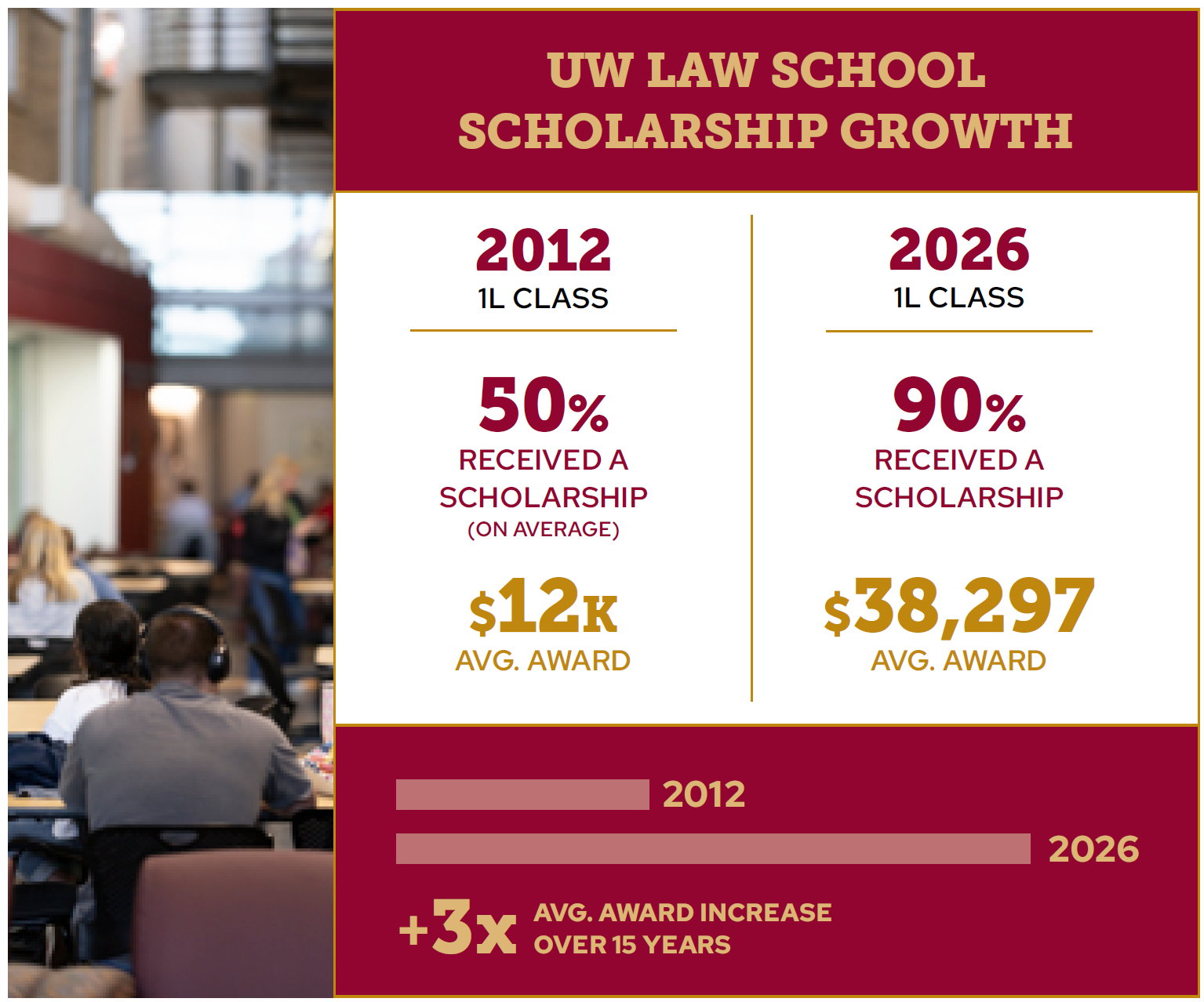
To keep legal education within reach, we’ve also increased the number and amount of our scholarships. In 2012, UW Law provided scholarship awards for over 50% of the incoming 1L class, with the average scholarship amount being just over $12,000. For this year’s 1L class (Class of 2028), 90% are receiving a scholarship, with the average award amount being $38,297.
This increase in scholarship support would not have been possible without our alumni’s help. Annual contributions during Fill the Hill, year-end and Day of the Badger campaigns all contribute greatly to our mission to produce attorneys who excel and align with the excellence we’re known for.
Debt Load — Another Barrier to Accessibility and Affordability
Managing tuition costs and increasing the number and amount of scholarships can deeply impact the debt load our students face after graduation. Our 2025 graduates’ average debt from their legal studies was $44,994. This is less than half the national average of $108,000.
“We are very proud that we can keep this number below that of our peers and the national average,” said Dean Dan Tokaji. “This allows our recent graduates to follow their passions without the burden of financial constraints.”
UW Law staff in the Office of Admissions and Financial Aid have worked hard to mentor our students to be more mindful about their expenses. They have created a “thrifty” budget that provides students with a snapshot of how some personal choices could lower their cost of attendance. For over a decade, UW Law has also hosted a national expert on student educational debt to provide programming about student loan repayment and offer one-on-one financial counseling.
Threats to UW Law’s Affordability
Despite all these great strides, we are facing a new challenge that will threaten access and affordability of a UW Law education.
Grad PLUS loans have long been a quiet but powerful force in assisting our students in attending law school regardless of personal financial resources. For years, these federal loans allowed students to borrow up to the full cost of attendance — tuition, fees and living expenses — on top of standard federal unsubsidized loans. That flexibility meant students could choose schools and career paths based on fit and mission.
That landscape is about to change.
Students from low income, first generation and nontraditional backgrounds will find it harder to bridge the gap between federal borrowing limits and the real cost of a legal education.
Beginning July 1, the Grad PLUS program will be phased out and replaced with lower, fixed federal borrowing caps for graduate and professional students. These new caps will fall short of the total cost of attendance for law school. The result is that future students will need to assemble more complex financial packages that may include increased reliance on scholarships, savings, family support or private loans that do not offer the same federal protections and are not available to many students.
The implications are significant. Students from low income, first generation and nontraditional backgrounds will find it harder to bridge the gap between federal borrowing limits and the real cost of a legal education. We know that many may not be able to bridge that gap and, as a result, will not be able to continue their education at UW Law.
SOS Initiative
Rather than sit back and let these shifts in federal loans negatively impact access to legal education, UW Law has launched the Support Our Students (SOS) Initiative. This allows naming rights for a scholarship fund established with a pledge of $30,000. This generous contribution can be paid in three annual installments of $10,000 and will support one law student during their entire educational experience.
This is new because naming rights were previously granted only to gifts large enough to endow a scholarship, $100,000. Donors can receive recognition and stewardship at a lower financial entry point and still determine whether the award is need- or merit-based.
Individuals do not have to do this on their own.
Firms, employers, multi-generational alumni/families and reunion classes are all examples of how people can band together to create an SOS scholarship.
“I’m excited about this new initiative and thrilled we have had alumni willing to partner with us,” said Dean Tokaji. “However, every gift matters regardless of the size. We are at a critical time where every gift will go to great use. Our Badger community is strong. I’m confident they will band together to help us keep UW Law School accessible and affordable.”
Learn how you can invest in the future of UW Law School.