‘This Work Matters’
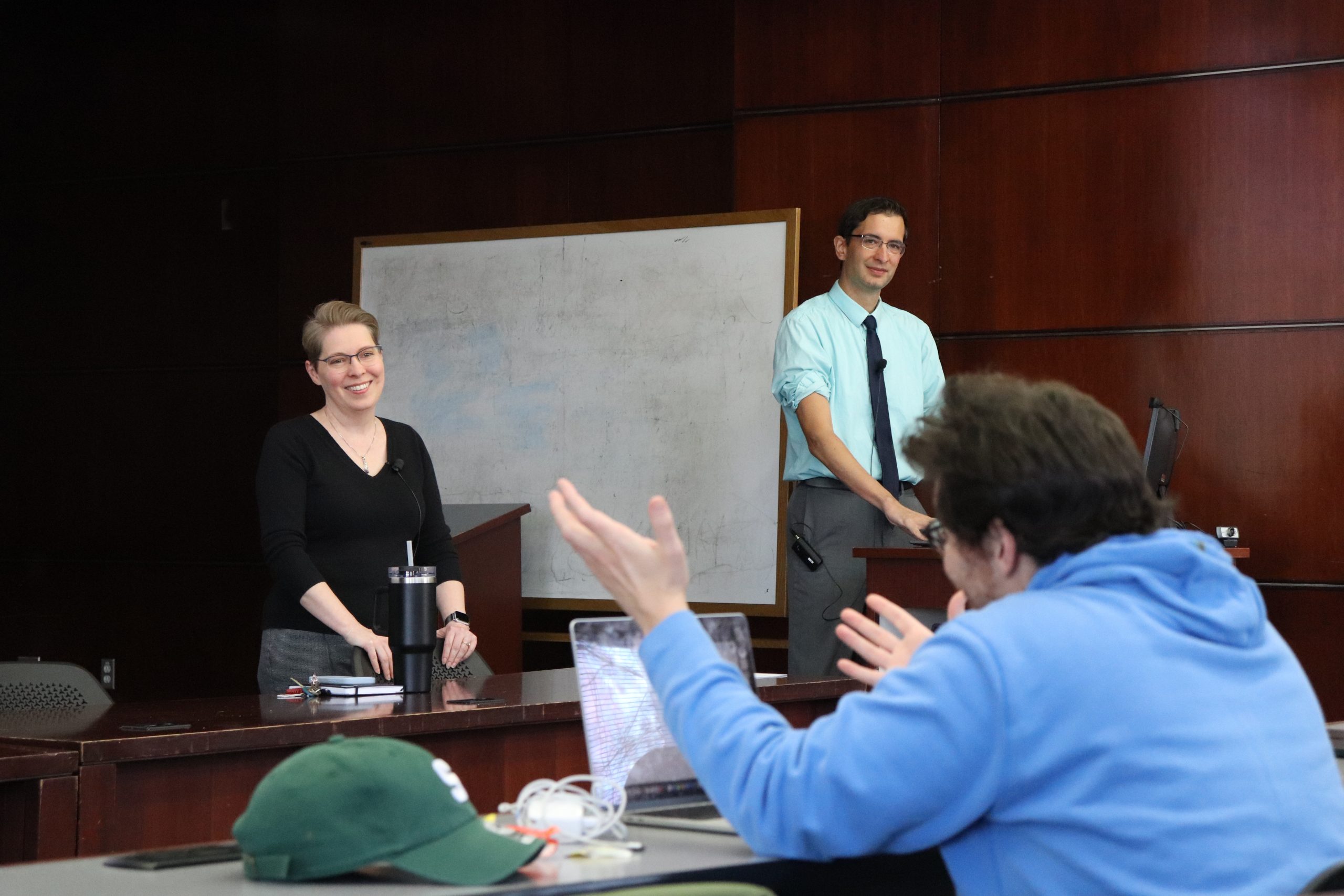
When ChatGPT launched in November 2022, many law schools were grasping what that meant. At the University of Wisconsin Law School Library, the call to action came swiftly.
Associate Dean and Law Library Director Bonnie Shucha ’14 and Associate Director of Public Services Kris Turner ’20 began integrating generative artificial intelligence into their Advanced Legal Research course in January 2023. They recognized early that the AI technology would not be just a passing trend.
“GenAI was a game-changer for research in particular and the legal profession in general,” Turner said.
What began in a classroom mushroomed into two parallel AI literacy efforts:
- A coordinated, Law School-wide program that prepares students for AI; and
- An outreach program that extends into the legal profession across Wisconsin and beyond in the spirit of the Wisconsin Idea.
In just three years, Shucha and Turner have reached more than 3,800 learners through various presentations from “Navigating Ethical and Effective Use of AI” to “Use of AI in Legal Research and Law.” UW Law Library’s AI literacy efforts recently earned the Excellence in Community Engagement Award from the American Association of Law Libraries (AALL). The honor underscores how this program is one of the most comprehensive AI education programs in legal academia.
“To have been chosen out of that tremendous group of colleagues means a lot,” Turner said.
Shucha and Turner have written for the State Bar of Wisconsin’s Wisconsin Lawyer magazine as part of its AI and the Law Series. Shucha is on the State Bar Communications Committee, which serves as the editorial board for the magazine, as well as the Wisconsin Courts AI Committee.
“In this law school, we’ve always taught students to think critically. With AI, that lesson is equally important.”
Individually, Shucha received a 2026 Section on Law Libraries and Legal Information Award from the Association of American Law Schools (AALS), while Turner was named a 2025 Mover and Shaker by Library Journal.
The timing of UW’s AI literacy efforts is critical. A recent study by LexisNexis, Aspen Publishing and Themis Bar Review found a widening gap between employer expectations and law school training.
For employers, AI literacy is expected, not optional.
One faculty member in the study said, “AI has come upon us quickly … we as faculty and staff are having a hard time keeping up, much less planning pedagogy.”
Turner noted that the widely reported cases of lawyers sanctioned for submitting briefs filled with AI-generated fake citations also fueled the urgency.
“That cemented our feelings about the importance of centering GenAI literacy,” he said. “Lawyers may see these tools as shortcuts instead of as tools that can boost efficiency.”
Campus-Coordinated Strategy
At UW Law, the impact of generative AI is being addressed across the curriculum. In 2023, the Law School convened an AI Working Group on which both Shucha and Turner served. The group drafted model syllabus language, consulted on the school’s AI policy and hosted trainings and discussions with faculty on navigating GenAI in their courses.
Faculty in Legal Analysis, Advocacy, and Writing, Professional Responsibility and clinics began integrating AI ethics and skills into coursework to prepare students for a profession increasingly shaped by AI. Doctrinal faculty, including the new RISE AI faculty, are exploring the law of artificial intelligence.
Beyond the classroom, professionals from IT, Career and Professional Development, Student Affairs and External Affairs are also addressing the impact of GenAI on students and the community.
“AI literacy touches every part of legal education,” Shucha said. “No single unit has all the expertise or access to all the students and audiences who need this education.”
The goal is for every UW Law graduate to have foundational AI literacy skills — not just technical familiarity, but the judgment to make informed decisions about whether and when to use GenAI, and when they do, to use it ethically and effectively.
“In this law school, we’ve always taught students to think critically,” Shucha said. “With AI, that lesson is equally important.”
Students are taught to evaluate outputs, recognize hallucinations, understand confidentiality risks and take responsibility for AI-assisted work.
“You can’t blame AI if something goes wrong,” Shucha said. “If you put your name on something, you own it completely.”
Living the Wisconsin Idea
The second track of the Law Library’s AI literacy efforts stretch far beyond Madison.
Turner and Shucha have made AI literacy an example of the Wisconsin Idea principle that university knowledge should extend statewide.
“This program goes to the border of the state in almost a literal sense,” Turner said.
They have traveled across Wisconsin and beyond to meet with attorneys, judges, court staff, Tribal judges, librarians and members of the public.
“Ethical and efficient AI use will make for better lawyers and consequently better legal service to the people of Wisconsin,” Shucha said.
The demand for this knowledge reflects how quickly AI is transforming practice. Alumni are seeing it in their firms, agencies and courtrooms.
“I’ve found that people will either be all-in on GenAI and rely on it too much or entirely bury their heads in the sand,” Turner said. “I think the right approach is in the middle.”
Shucha adds that simple avoidance is not enough.
“You need to understand what these tools can and can’t do, what the risks are, and what your ethical obligations are — whether you choose to use AI or not,” she said.
That view aligns with the 2024 American Bar Association Formal Opinion on Generative Artificial Intelligence Tools, which concludes that lawyers should become familiar with Gen AI tools to make an informed professional judgment about whether to use them or to accomplish the work by other means.
“In this law school, we’ve always taught students to think critically. With AI, that lesson is equally important.”
That balanced approach is central to both literacy programs. Participants are urged to read service agreements, understand confidentiality implications and check court and employer policies. They are asked to consider motivation.
“AI tools can help you surface relevant information quickly, organize complex arguments or draft more efficiently, but your voice and professional judgment are yours alone,” Shucha said.
The legal profession has navigated technological change before, from online research to e-discovery. AI is more complex and evolving faster. But the underlying challenge is familiar: ensuring lawyers have the knowledge, skills and judgment to serve clients ethically and effectively.
The question is not whether the profession will adapt. It must. The question is whether adaptation will come through coordinated planning or reactive trial and error.
At UW Law, the answer is deliberate — equipping lawyers to think critically about AI, make informed decisions about when and how to use it and have the skills to do so effectively.
“The demand tells us this work matters,” Shucha said. “AI literacy is fundamental to good lawyering.”
By Brian Walker