Behind the Success
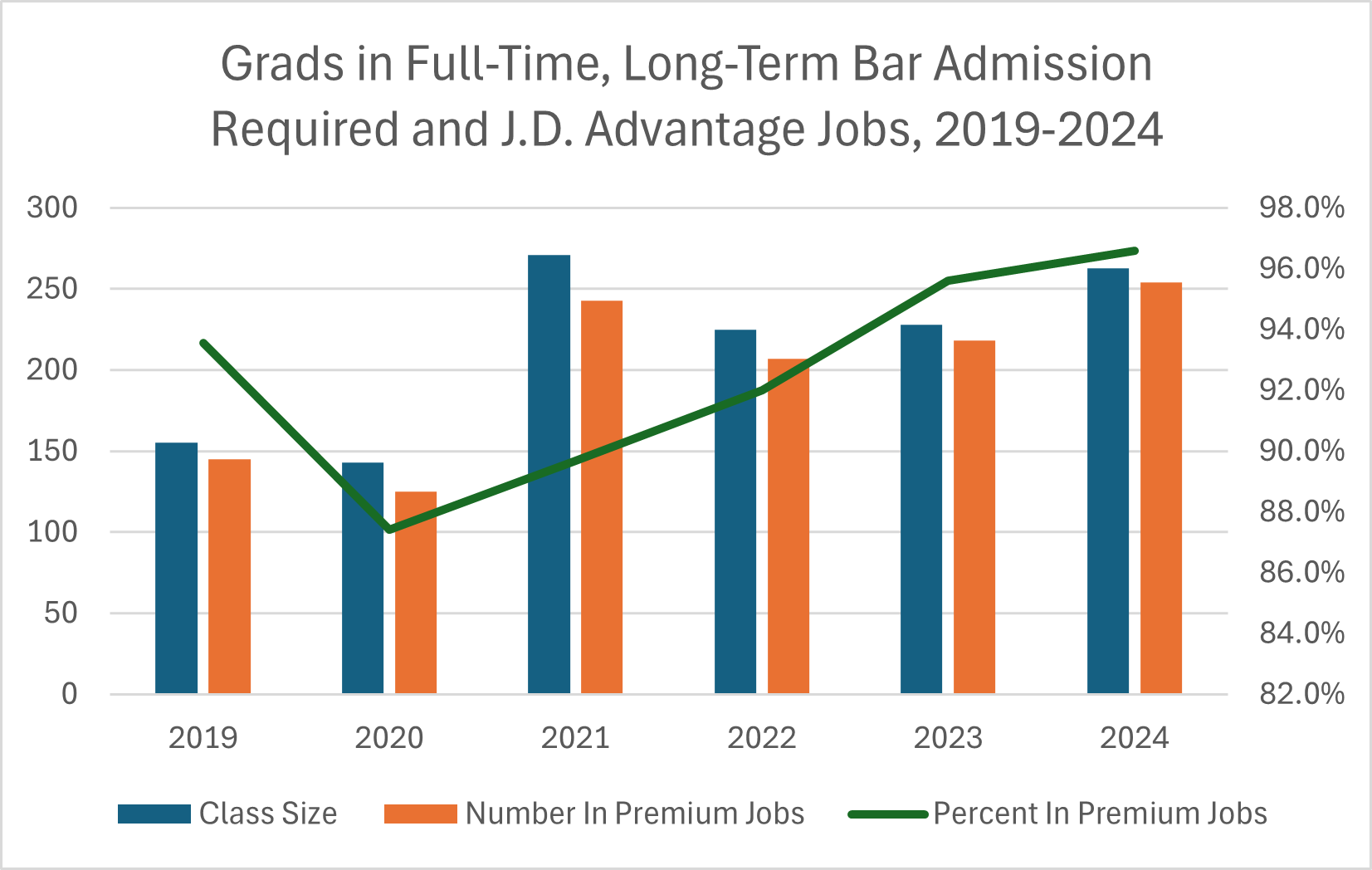
The Class of 2024 entered the professional world with remarkable momentum: 90.1% of students were already employed at graduation, and 10 months out, 96.6% were employed in full-time, long-term bar admission required or J.D. advantage jobs. This is the highest employment rate in those sought-after jobs in the last five years, with numbers growing each year since 2020.
These results are closely tied to the efforts of University of Wisconsin Law School‘s Office of Career and Professional Development (OCPD), where advisers work closely with students to cultivate professional skills and connect them to meaningful opportunities.
Previously known as the Career Services Office, the team has assisted students in their careers for decades and has evolved alongside their needs, with the name change in 2013 reflecting the broadening of its mission.
“We do much more than just connecting students with job opportunities,” explained Associate Dean of Career & Professional Development Emily Kite, who directs the office. “As the name implies, we’re focused on the professional development of students, which entails exposure to various practice areas students might pursue, hosting networking opportunities and helping students develop skills essential in the job search.”
To advance these goals, OCPD combines a variety of strategies to help students determine their career goals and how to achieve them.
Building Connections
“The best way to expand students’ understanding of what the practice of law can look like is to meet people who practice law in various settings,” said Kite.
Alumni are an essential part of that mission; they serve as panelists, attend tabling events on behalf of their employers and participate in networking events with students.
While these opportunities provide students with an understanding of the practice of law, at the same time, they offer them an easy ramp into networking — an important skill in both searching for a job and practicing as an attorney, Kite explained.
“We want to make some low-stakes opportunities available to students where they can practice their networking skills, but then also truly build connections that might help them in their job search later,” she continued.
Alumni also help OCPD monitor market changes and prepare students for them.
“We want to know, what are they seeing from graduates? What are the challenges they’re running into?” Kite explained.
Additionally, OCPD also engages with legal recruiters, working groups and committees to gain insight into law firms’ needs and priorities, as well as what other schools are doing. These takeaways are then adapted and applied to each student by their assigned career adviser, who listens to the student’s career needs and helps them progress toward their goals.
Individualized Advising
Each student has different goals, needs and degrees of familiarity with the law profession. In addition to Kite, OCPD directors and associate directors advise students while taking on a variety of additional roles.
“As someone without lawyers in my family, I often felt clueless about what a career in law actually looks like in practice and felt as if I was running to catch up with my peers, who sometimes had more familiarity or experience,” said Teresa Kulick ’24. “It was overwhelming to learn how to be a law student and focus on my curriculum while also trying to understand what I wanted my career to look like and how I could get there.”
Meeting with a career adviser helped her slow down and see career planning as part of her education, something she could study and learn.
“My adviser gave me the language and tools I needed to understand, articulate and accomplish my goals,” she said.
Those conversations helped her understand her own abilities, goals and potential.
“I was able to move away from what I previously thought I ‘could’ or ‘should’ do and toward what I actually wanted to do,” Kulick said. “Individualized advising provided a much-needed space to ask ‘stupid’ questions and familiarize myself with different legal career paths.”
While OCPD has always offered one-on-one advising, it’s become an increasing priority in recent years.
“Realizing how important these one-on-one meetings are, and with Dean Dan Tokaji’s support, in the 2023-24 academic year, we were able to require a meeting with OCPD before 1Ls could register for 2L classes, ensuring that every 1L had at least one touch with our office,” explained Kite.
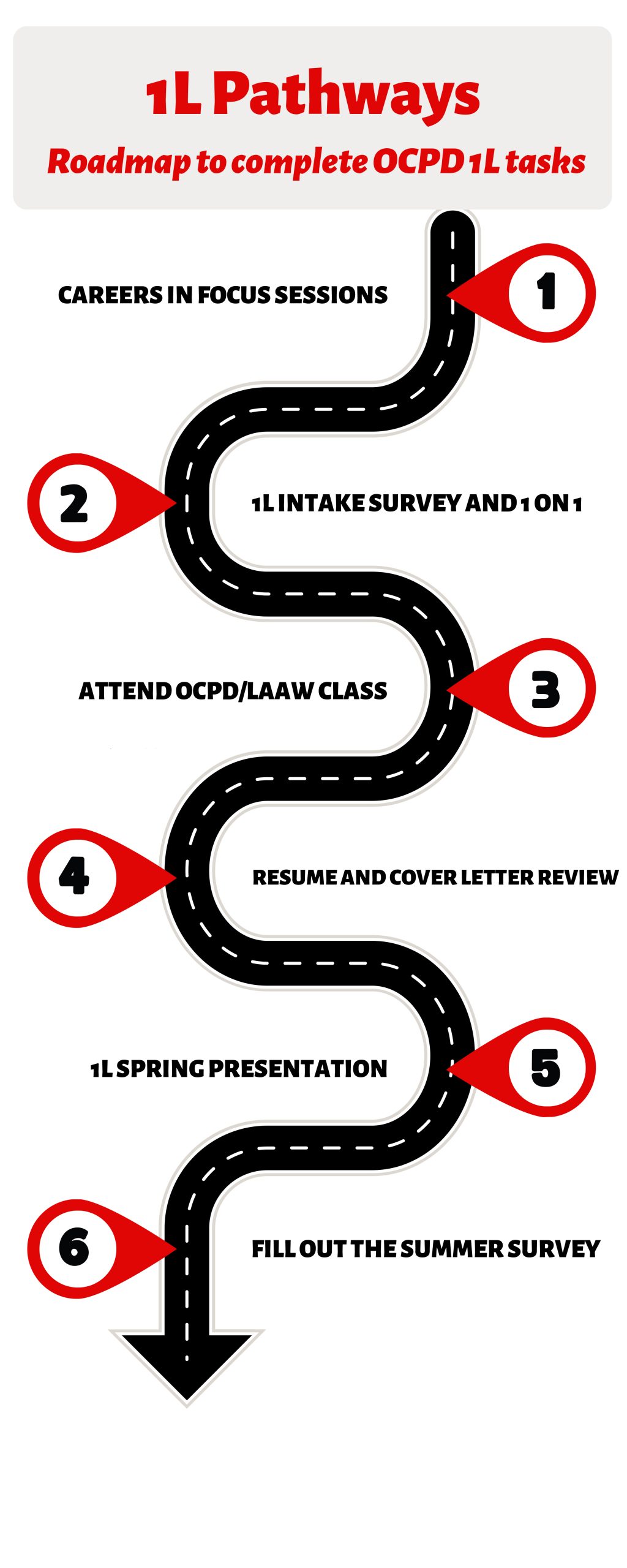
The following year, OCPD introduced the 1L Pathways program, which guides first-year law students through the job search process one step at a time.
“Instead of throwing everything at them at once like legal resumes, cover letters, application timelines and interviewing strategies, the pathways program breaks that information down and delivers it in a more manageable, timely way throughout their first year,” explained Director of Career Counseling Megan K.S. Zurbriggen, who manages the program, which is designed with built-in flexibility.
“My adviser gave me the language and tools I needed to understand, articulate and accomplish my goals.”
“We offer a bit of a ‘choose your own adventure’ approach, especially in the fall with our Careers in Focus panels,” said Zurbriggen. “These sessions break down different paths — like private practice, public interest and government — so students can explore what interests them most.”
These panels provide students with foundational information on different legal career paths, which helps set the stage for their one-on-one intake meeting with their adviser. As the adviser learns more about each student’s interests, they can suggest additional programming tailored to the students’ specific needs.
“If a student shares that they’re interested in labor and employment work in Michigan, we can point them toward relevant opportunities like our Labor and Employment Pizza with Professionals event, an upcoming out-of-state job search call focused on Michigan and alumni connections in that market,” Zurbriggen said. “It’s all about giving students meaningful ways to network, gather information and connect with attorneys in their areas of interest.”
The intense early focus on individualizing their job search enables OCPD to help students even as recruitment cycles shift. With earlier recruitment times every year, it is more important than ever that students start planning their career strategies soon after they begin their studies.
Recruitment Today
The recruitment process for law students has changed dramatically in the last decade.
Before 2018, members of the National Association of Law Placement (NALP) adhered to guidelines that limited when career advisers and employers could first engage with students, when recruitment could begin and set deadlines by which students had to respond.
In 2018, those guidelines ceased to be binding, and after a brief pushback in recruiting times during the COVID-19 pandemic, there has been a growing recruitment creep, particularly with big law firms.
With the guidelines, 1Ls couldn’t seek advice on their career search from career development professionals until Oct. 15, and employers couldn’t accept applications until Dec. 1. Last year, 1Ls applied to the biggest law firms for both their first and second summers as early as October, going to interviews before even receiving their first-semester grades.
“They were applying with no knowledge of what their grades were going to be, and for some of them, without even a certainty that big law was what they wanted to do, because they felt, and possibly rightly, that if they didn’t pursue it now, it might be an opportunity that was missed,” explained Kite.
In response, OCPD adapted its pathways program, incorporating into the fall semester processes that would normally come much later in the academic year.
“OCPD started training incoming students on legal resumes and cover letters before classes even began,” explained Zurbriggen. “We really try to stay flexible and make sure we’re giving students the most relevant, timely guidance each year.”
And while tailoring resumes and applications can be a challenge when students have barely started law school, it is not one they face without support.
Summer Jobs and Externships
Students have less time to decide what they want to do before applying for summer jobs, but the jobs themselves are a great opportunity for career exploration.
“We often tell students that for their first summer, we want them to work somewhere where they are getting legal experience,” Kite said. “It doesn’t have to be what they’ll be doing forever. In fact, sometimes figuring out what you don’t want to do is as important as figuring out what you do want to do.”
Career exploration was a big part of Kulick’s experience working as a summer associate at Reinhart Boerner Van Deuren s.c., where she is now an associate attorney in the firm’s Employee Benefits and Institutional Investor Services practices. During her 2L summer at the firm, she met attorneys at all levels across all practice groups.
“That gave me hands-on experience and new familiarity with areas of law I had never even heard of, let alone seriously considered as a career path,” she said. “It was a random assignment from an employee benefits shareholder and subsequent conversations with other members of that group that brought me to my current role.”
“OCPD started training incoming students on legal resumes and cover letters before classes even began. We really try to stay flexible and make sure we’re giving students the most relevant, timely guidance each year.”
It is common for summer internships to lead to a postgraduate offer, but depending on the field and company, students can continue working before graduating.
Students working for smaller local firms sometimes work part-time throughout the school year, but many other types of jobs can also continue as externships, in which students work for course credit while receiving mentoring and supervision from an in-house Law School faculty member. OCPD manages two of the Law School’s externship programs.
“For example, I have a student who spent the summer at the federal defender’s office here in Madison, and they are now working with me for class credit to continue to do work for that organization,” said Kite.
Jobs available for externships include public interest and government (fields in which traditionally about one-third of UW Law students pursue, higher than the national average), the judiciary, Native nations and more.
Impact
For students, the impact of OCPD’s work is felt long before they accept a job offer. It shows up in the early conversations where they sort through interests, in the confidence that builds from practicing networking and in the sense of direction that begins to take shape as they talk through each option with an adviser who understands their career path.
OCPD’s work continues to shift in response to what students need now, as timelines and markets change. Students experience this evolution through clearer guidance, stronger preparation and support that meets them where they are in the process, from their first semester to the start of their career. By the time they become graduates, they have already spent years developing the skills and self-knowledge that will guide their professional lives.
The success of the Class of 2024 shows how these ongoing improvements help students navigate the fast-moving legal landscape and enter the profession with confidence in their next steps.
How UW Law Can Help Your Job Search
OCPD does not just serve students; staff continue to help UW Law alumni post-graduation. Recent alumni can use the OCPD job board to find entry-level positions, and those who have been out of school for a while and are considering a career pivot or just want help updating a resume can email career@law.wisc.edu.
How You Can Help Today’s Students
There are many opportunities for alumni to get involved with OCPD’s efforts — both in person and virtually — such as listing job postings, participating in on-campus interview programs, attending panels and networking events, serving as a resource for students seeking guidance on their job search and more. Additionally, OCPD welcomes alumni to reach out with ideas for engaging in the student experience.
Last semester, Kite said, people from the Marathon County Bar Association provided pizza and discussed the benefits of living in Wausau.
“We were happy to host that and facilitate those conversations, but it was really their brainchild,” Kite said.
Alumni interested in engaging with OCPD can get in touch with the employer relations coordinator by contacting career@law.wisc.edu.