Examining Law in Action
Across different geographies, time periods and legal fields, the work of Sumudu Atapattu, Alexandra Huneeus, Heinz Klug and Mitra Sharafi shares a common goal: to examine law in action.
From environmental rights in South Asia to constitutional transformation in South Africa, from international law in Latin America to forensic practices of colonial India, the authors seek to understand how law operates not as an abstract system of rules, but as a lived, evolving force shaped by institutions, politics and people.
We spoke with all four faculty about their recently published or forthcoming works, exploring the impetus for their projects, the timeliness of the topics, what separates their research from others in the field and more.
Sumudu Atapattu

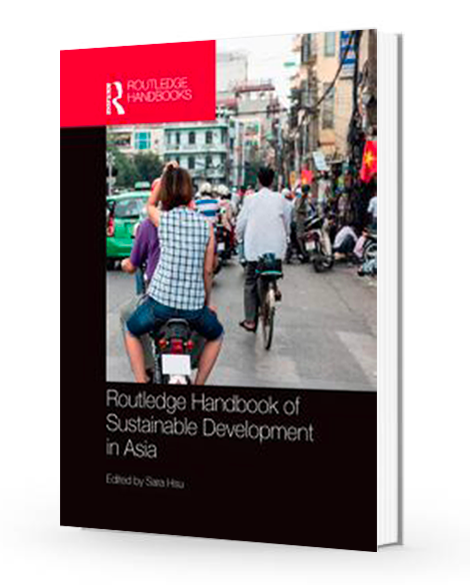
A leading scholar at the intersection of human rights and environmental law, Sumudu Atapattu, teaching professor at University of Wisconsin Law School, director of the Global Legal Studies Center and executive director of the Human Rights Program, has built a career on examining how global legal frameworks respond to the lived realities of climate change and environmental harm.
In her new edited volume, “Routledge Handbook on Environmental Law and Sustainable Development in South Asia,” Atapattu examines how legal principles are not only articulated but actively applied across the region. The book, which will be available in the fall, adopts a law and society approach with sustainable development, environmental justice and environmental rights as the main frameworks.
Question: How would you describe the central argument of your new book?
Answer: The core questions we were keen on answering were: 1. What are the main developments relating to environmental law and sustainable developments in each country in the region, and what are the main obstacles? We used the definition of South
Asia adopted by the South Asian Association for Regional Cooperation (SAARC) and examined eight countries — Afghanistan, Bangladesh, Bhutan, India, Maldives, Nepal, Pakistan and Sri Lanka. 2. What are the regional (mostly environmental) challenges that South Asia is facing? 3. How is the region addressing regional/ global challenges such as climate change? 4. What are the lessons we can learn from South Asia, especially in relation to its remarkable jurisprudence relating to environmental rights?
Q: What drew you to this project, and how does it reflect or build upon your broader body of scholarship?
A: A few years ago, a friend asked me to recommend a book on environmental law in South Asia, and I couldn’t find one. So I decided to fill that void! While individual countries in the region have received scholarly attention, the region as a whole had not.
At the same time, there are many jurisprudential developments in the region that are unknown to other parts of the world. This is the first book that looks at environmental challenges and jurisprudential developments in South Asia from a regional perspective.
Q: Why is this book particularly timely?
A: In 2022, the U.N. General Assembly recognized, for the first time, the right to live in a safe, healthy and sustainable environment as a human right. Given this monumental and long-awaited development, this book is timely as it provides an excellent example of this right being used in practice long before the U.N. recognized this right.
Judiciaries in South Asia interpreted existing rights such as rights to life, equality and dignity expansively to include a right to a healthy environment, and this book provides examples of state practice in the region.
Q: What distinguishes this book from other scholarship in this area?
A: There are no books that look at environmental jurisprudential developments in the region as a whole. Thus, our book fills an important void in literature. It also adopts a law and society approach to see how law is actually applied on the ground and how law shapes society and vice versa.
Another unique feature of the book is interviews with pioneers in the field. Environmental law in South Asia was born out of the work of a few dedicated individual lawyers/activists in the region, and we wanted to capture their experience in the book both to memorialize their experience and to encourage the younger generation to follow their lead.
Alexandra Huneeus

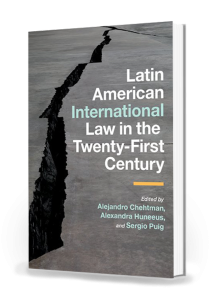
An internationally recognized scholar of public international law and human rights, Alexandra Huneeus, Evjue-Bascom Professor of Law and director of the Center for Law, Society and Justice, focuses her work on how legal norms are shaped, contested and implemented across Latin America.
In her recent co-edited volume “Latin American International Law in the Twenty-First Century,” Huneeus examines the region not as a passive recipient of legal norms, but as an active site of legal innovation and debate, revealing Latin America as a dynamic laboratory where the meaning and future of international law are actively being shaped.
Question: How would you describe the central argument of your new book?
Answer: At its core, the book asks a deceptively simple question: What does international law look like when we take Latin America seriously as a site of legal thought, institutional experimentation and norm production? Much of the traditional literature treats Latin America primarily as a recipient of international law — rules developed elsewhere and implemented locally. Our contributors challenge that view.
Q: Why is this book particularly timely?
A: We are living through a moment of significant transformation in the international legal order. Power is shifting globally, and many of the assumptions that shaped international law during the late 20th century are being reexamined. Latin America is deeply implicated in those changes.
The region has been at the forefront of debates about human rights adjudication, environmental protection, Indigenous rights and the interaction between domestic and international law. In that context, we felt it was important to take stock: How is international law evolving in Latin America, and how might those developments shape the global field going forward?
Q: How does this book advance or reshape conversations within your field?
A: Latin American jurists have historically developed important doctrines — from ideas about non-intervention to early contributions to human rights law. Yet those contributions are often treated as historical curiosities rather than as part of a continuing intellectual tradition.
The book argues that there is now a renewed and more self-conscious body of scholarship that is rethinking the region’s role in the discipline. This scholarship is also increasingly interdisciplinary, engaging with sociology, anthropology, political science and history to understand how international law actually operates in practice.
By bringing these perspectives together, the volume aims to show that Latin America is not just a site where international law is applied — it is also a place where the meaning and future of international law are being debated and reshaped.
Q: What distinguishes this book from other scholarship in this area?
A: First, its scope. The volume includes more than 30 essays that span both historical and contemporary topics — from colonial-era jurisdictional disputes to contemporary debates about internet governance and public health regulation.
Second, its methodological diversity. Rather than presenting a single theoretical framework, the book brings together scholars using different approaches.
Finally, the book tries to capture the plurality of voices within the region. Latin America is not a monolith. Different countries, legal traditions and political histories shape how international law is understood and mobilized. By assembling scholars from across the region, we hoped to reflect that diversity.
Heinz Klug

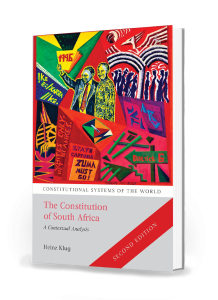
A comparative constitutional scholar whose work is deeply shaped by lived political transformation, Heinz Klug, John and Rylla Bosshard Professor of Law, has spent decades examining how constitutions function in practice — particularly in the context of South Africa’s transition from apartheid. Klug participated in the anti-apartheid struggle, spent years in exile and later contributed to post-apartheid reform efforts, including work with the African National Congress and South African government ministries.
In his newly revised edition of “The Constitution of South Africa: A Contextual Analysis,” Klug examines how a transformative constitution has operated over 30 years, asking how constitutional principles have been interpreted, institutionalized and at times constrained by persistent inequality.
Question: How would you describe the central argument of your new book?
Answer: My new book is a second edition of an original book that I wrote entitled “The Constitution of South Africa: A Contextual Analysis.” I originally published the first edition in 2010, which was only 16 years after South Africa moved away from apartheid.
The constitution that this book covers is the 1996 constitution, so this year is the 30th anniversary of the constitution. I was asked to do a new version of the book, and usually, with a second edition, you add just a little bit to update. But 30 years later, it is a different world, so this second edition essentially is a rewrite of the book.
Q: What drew you to this project, and how does it reflect or build upon your broader body of scholarship?
A: I’ve worked on constitutionalism in South Africa and Africa for a long time. My first book explored the political transition in South Africa and the construction of this constitution. When I wrote the first edition in 2010, I looked at how this constitution was being implemented and what was happening to it. And now is an opportunity to look back 30 years and ask what’s become of it, what’s going on in the jurisprudence, in the institutions and in the society.
Q: Why is this book particularly timely?
A: First, it’s been 16 years since that first book came out, so things have changed and it’s worth updating. But it isn’t just simply an update. The underlying deeper issue is that this constitution was constructed to try and address the legacies of apartheid. The fact that South Africa remains one of the most unequal countries in the world means that the constitution clearly hasn’t achieved that. So, what is it about a constitution that can or cannot achieve major socioeconomic and political changes?
Q: What makes this book unique?
A: I think the uniqueness of the book is that it is still the only book that covers the constitution as a whole. There are enormous amounts of scholarship on rights in South Africa, on socio-economic rights and on specific constitutional issues. This is the only book that tries to explore what has happened to this constitution as a whole and tries to provide that kind of overview. The first edition of the book was picked up by a lot of people, and it was used to teach constitutional law in South Africa. It gets picked up by others in debates, and that’s the contribution in my opinion.
Mitra Sharafi

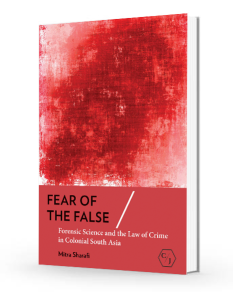
A legal historian whose work bridges law, science and empire, Mitra Sharafi, Evjue-Bascom Professor of Law, focuses on how legal systems operate in practice within the complex social worlds of colonial South Asia. In her new book, “Fear of the False: Forensic Science and the Law of Crime in Colonial South Asia,” Sharafi offers a grounded account of law in action, revealing how legal rules and scientific expertise were negotiated, applied and at times distorted in colonial legal systems.
Question: How would you describe the central argument of your new book?
Answer: My book reveals colonial India’s critical role in the development of forensic science. Colonial officials believed in “native mendacity,” and their suspicion that fake evidence was being planted led to advances in forensic testing relating to bloodstains, poisons and sperm cells. But in trying to detect falsity from without, namely evidence planted by colonized tricksters to frame rivals and subvert the colonial legal system, the new forensic institutions enabled falsity from within through their treatment of government lab experts, who were excused from cross-examination in court.
This feature of Indian criminal procedure, which differed from the rule in England and which lives on across South Asia today, made wrongful convictions more likely as it provided cover for expert misconduct. In the book, I ask: What was colonial about colonial forensics? My book examines how the colonial context affected the interaction of law and science through the quest to root out falsity.
Q: What drew you to this project, and how does it reflect or build upon your broader body of scholarship?
A: While doing archival research for my first book at the Bombay High Court, I came across a case from the Parsi Chief Matrimonial Court that featured medical experts locked in a “battle of the experts” in a 1927 case on abortion. I ended up using this case to write an article on abortion in colonial India, now the subject of a recent symposium on comparative histories of abortion.
But my interest in experts in the courtroom grew, and then I discovered the annual reports of the chemical examiners, who were military physicians running regional toxicology labs across colonial India and Burma. I spent several summers going through these reports, initially at the British Library and then (more closely) on my front porch here in Madison.
My first book is about law and religion; my second is about law and science. Both are explorations of knowledge production systems in a colonial setting. Both explore how a diversity of value systems — whether religious, cultural, scientific or medical — interacted with the colonial legal system.
Q: Why is this book particularly timely?
A: In India, a new version of the criminal procedure statute recently became law, and the colonial-era rule excusing government lab experts from appearing in court has been expanded to include more groups of experts than ever before. I hope that my book will provide the longer history of this rule — how it came to be, how it has persisted and grown and why it erodes defendants’ due process rights.
Fortunately, judges could start calling these experts to court under the existing legislation; a change in the legislation is not technically required. I hope that my work will convince more judges in India to start calling these experts to court.
Q: What distinguishes this book from other scholarship in this area?
A: This book is the first book-length study of false evidence, and the fear of false evidence, in colonial India. It will make an original contribution to South Asian legal history through its portrait of forensic institutions and testing, as well as criminal procedure, in the late 19th and early 20th century. Most of the material I found at the National Archives of India and the British Library has not been used by scholars. These archives house vast collections of primary sources from British India.
Interviews by Kassandra Tuten and Leo Barolo Gargiulo